Related guide
Fidget Tools for School
Which fidget tools are realistically allowed in a UK classroom, which ones get taken away, and how to get one agreed with the teacher in advance.
What self-stimulatory behaviour is doing, why stopping it costs a child more than it saves, and the two situations where stepping in is the right call.
I'm a parent, not an occupational therapist. This guide describes what research and autistic people themselves report about stimming. If a stim is causing injury, that needs assessment by a professional rather than a change you make at home. Speak to your GP about an occupational therapy referral.
Stimming is short for self-stimulatory behaviour: repeated movements, sounds or sensory actions that a person does because of how they feel to do. Hand flapping and rocking are the examples everyone knows. Foot jiggling, hair twirling, humming, pen clicking, repeating a favourite line from a film and running a thumb along the edge of a table are all the same thing.
For a long time, stimming was treated as a symptom to be reduced. A child who flapped was taught to keep their hands still. The reasoning was that the movement looked odd and drew attention, and that stopping it would help the child fit in. What that reasoning never asked was what the movement was doing.
The research now available, much of it built on asking autistic people directly, gives a fairly clear answer. Stimming regulates. It manages sensory input, discharges emotion, holds attention, and expresses feelings that words don't reach. Removing it removes the regulation and leaves the child with the same problem and one fewer way to handle it.
This is the least controversial fact on this page and the one that changes the most conversations. Bouncing a knee in a waiting room, clicking a pen through a meeting, twirling hair while reading, chewing a pen lid, cracking knuckles, pacing on the phone. All stimming. None of it gets a clinical name because nobody minds it.
What differs for autistic and ADHD children isn't the existence of the behaviour. It's the intensity, how often it's needed, how visible it is, and how much it matters to be able to do it. A neurotypical adult who can't jiggle their foot is mildly irritated. An autistic child who can't rock may lose the ability to process what the teacher is saying.
If you find yourself about to stop a child from stimming, the useful question is not "is this appropriate" but "what is this doing for them, and what would replace it". If the honest answer to the second question is "nothing", then stopping it is a straight subtraction from their capacity to cope.
Stimming maps onto the sensory systems. Knowing which system a child's stims are targeting tells you something useful about what they're short of, or overloaded by, and it's the same information a sensory diet is built from.
Watching spinning objects, flicking fingers in front of the eyes, staring at lights, lining things up, watching the same clip repeatedly. Often calming when the visual environment is chaotic, and often driven by the pleasure of predictable movement.
Humming, repeating words or phrases, making the same sound over and over, replaying a song on a loop. A self-made sound is predictable in a way that a classroom isn't, and it can mask input the child can't otherwise escape.
Rubbing a specific fabric, picking at skin, stroking hair, squeezing, tapping fingertips. Touch stims tend to increase when a child is anxious and when they're understimulated, which is why they can look contradictory.
Rocking, spinning, swinging, head shaking, hanging upside down off the sofa. This is the balance system asking for input. Proprioception and the vestibular sense covers why movement is so regulating for some children.
Crashing into cushions, stamping, pressing hands together, jumping, chewing hard. Deep pressure and heavy work through the joints and muscles, which is generally the most reliably calming input available.
Chewing sleeves, collars, pencils, hair. Extremely common, frequently destructive of school uniform, and the easiest of all to redirect safely with a chew necklace or a handheld chew toy.
Smelling objects, people or food before engaging with them, licking things, seeking out a specific smell. Less talked about, and usually harmless.
The most cited research here is a 2019 study by Kapp and colleagues at Exeter and UCL, which interviewed 32 autistic adults about their own stimming. Two things came out of it. The first is that autistic adults describe stimming primarily as self-regulation. The second is that they object to interventions aimed at eliminating it.
Underneath that, the functions divide roughly into four.
Adding predictable input when the environment is chaotic, or supplying input the body is short of. A self-generated signal is controllable in a way that the outside world isn't.
Discharging anxiety, excitement, frustration or overwhelm through the body. This is why stimming increases sharply before a meltdown and often prevents one.
Movement occupies the part of the brain that would otherwise wander, freeing the rest to listen. A child fidgeting while you talk is frequently listening harder, not less.
Flapping because something is brilliant. This one gets targeted for suppression more than any other, and it's the one with no downside whatsoever.
The early-warning use is worth knowing about. A sharp increase in stimming is one of the most reliable signals that a child is approaching their limit. If you learn your child's escalation stims, you get a window to reduce demands before things tip over. Meltdowns and shutdowns covers what that tipping point looks like and what helps at each stage.
Jude bounces. On the sofa, on the bed, on the trampoline, on the spot in the kitchen while he's telling me about something. For years I heard myself saying sit still and eventually noticed that the sitting still lasted about forty seconds and the conversation fell apart immediately afterwards. He talks better bouncing. It took me an embarrassingly long time to stop treating that as a problem to solve.
Suppressing stims is a form of masking, and it carries the same costs. Autistic adults consistently report that hiding stims takes conscious effort, that the effort is tiring, and that the regulation the stim provided doesn't get replaced.
Research also finds that people who suppress a preferred stim often substitute a different one, and that substitutes tend to work less well. Some substitutes are worse than the original: a child stopped from flapping may start picking at skin instead, which is quieter, more socially acceptable, and considerably more harmful.
The longer-term picture is well documented. Sustained suppression of autistic traits is associated with anxiety, depression and autistic burnout. There's also evidence that holding still takes enough executive effort to interfere with attention, which means a child ordered to keep their hands still may genuinely be less able to follow the lesson afterwards.
The historical source of most of this is worth naming. "Quiet hands" was a standard instruction in early behavioural intervention, and the autistic adults who grew up with it have written extensively about what it cost them. The practice was never based on evidence that stopping the movement helped the child. It was based on the movement looking unusual.
There are two situations where a stim needs addressing, and neither is about appearance.
Head banging, hard biting, skin damage. This needs professional input rather than a home fix. Talk to your GP and ask for an occupational therapy referral, and ask for a functional assessment: self-injurious stimming is usually driven by pain, extreme overload or an unmet need that can't be communicated, and the useful intervention addresses the driver rather than the movement.
Throwing objects, spinning in a space where they'll hit a younger sibling. Here the fix is usually environmental: a designated place and time where the same input is available safely.
In both cases the aim is substitution rather than elimination. Find the sensory input the stim is providing and offer a route to the same input that doesn't cause harm. A child who chews destructively needs something safe and satisfying to chew, not a lecture. A child who crashes into furniture needs somewhere to crash, which is what crash mats exist for.
Embarrassment is not a clinical reason. If the only cost of a stim is that it looks unusual in public, the problem is worth locating in the room rather than in the child. That's a much easier thing to write than to feel in a supermarket, and I'm not pretending otherwise.
School is where this gets hardest, because a teacher is managing thirty children and a stim that helps one child can distract others. That tension is real, and the workable answer is usually a quiet, agreed alternative rather than a ban.
What tends to get agreed in UK classrooms: a silent, non-visual fidget kept in a pocket, a chew tool worn on a lanyard, a wobble cushion or a chair band so movement happens at the desk, permission to stand at the back, and a card that allows leaving the room without asking. My guide to fidget tools for school covers which ones survive contact with a classroom and which get confiscated by Wednesday.
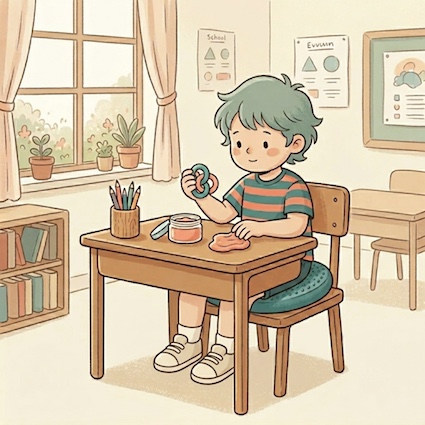
Which fidget tools are realistically allowed in a UK classroom, which ones get taken away, and how to get one agreed with the teacher in advance.
The conversation goes better when it's framed as access rather than preference. A child who needs to move to listen is in the same category as a child who needs to sit at the front to see. If you want that written down, my Sensory Profile and Communication Passport gives you one page to hand over that says what she does, why, and what to do about it.
None of these are treatments, and none of them stop a child stimming. What they do is give the same input in a form that's safer, quieter, or allowed somewhere it otherwise wouldn't be.
Chew necklaces for children who chew collars and sleeves, or handheld chew toys for older children who'd rather not wear something visible.
Fidget toys for general use, and therapy putty where the child wants resistance rather than movement.
A mini trampoline indoors, crash mats for a child who throws themselves at furniture, or a spinning chair for a child who seeks rotation.
Body socks and weighted blankets give whole-body deep pressure, which is often what a child squeezing into small spaces is looking for.
You'll need a version of this for teachers, grandparents and strangers, and shorter is better.
For school: "She needs to move to concentrate. If she's still, she's using her attention on being still." For family: "It helps him regulate. He'll stop when he doesn't need it." For a stranger in a shop: nothing at all is a complete answer.
The one worth pushing back on is any version of "she'll never learn if you let her". Autistic children don't stop stimming because they've matured out of needing regulation. They stop because they've learned to hide it, and the cost of that shows up later, usually as burnout. Girls in particular are corrected out of visible stims early, which is one reason autism in girls goes unrecognised for so long. My guide to signs of autism in girls covers that pattern.
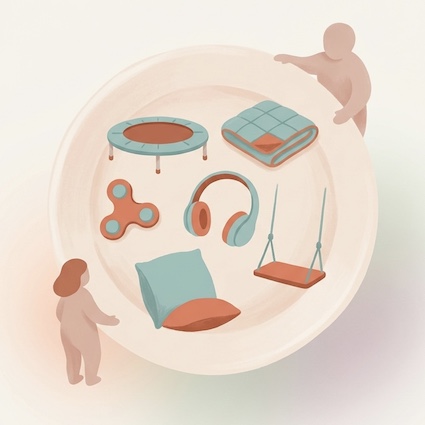
How to work out which sensory input your child is seeking or avoiding, and build regular activity into the day so the need is met before it becomes urgent.
Stimming is regulation, not a habit. It tells you something about what a child's nervous system is short of or overwhelmed by, and it usually tells you before anything else does. Unless it's causing harm, the right response is to make room for it, and if it is causing harm, the right response is to find out what it's for and meet that need another way.
The children who do best with this are, in my experience, the ones whose parents stopped treating the movement as the problem and started treating it as information.
What parents ask most often about stimming.