Related guide
Fidget Tools for School
Which fidget tools are realistically allowed in a UK classroom, which ones get confiscated, and how to get one agreed with the teacher in advance.
Why the return to school is harder than it looks, what to sort before day one, and what to do when the second week is worse than the first.
I'm a parent, not a teacher or a SENCO. This guide is based on my own family's experience of going back to school, the SEND Code of Practice, and guidance from the National Autistic Society and IPSEA. Every school does this slightly differently, so treat what follows as a shape to adapt rather than a rule to follow exactly.
Going back to school is the hardest recurring transition in a neurodivergent child's year, and it's the one that gets the least support. A new school year means a new teacher, a new room, a new seat and a new set of unwritten rules, all arriving in the same week. A return in January or after a half term is gentler on paper, and still costs more than most people expect.
This guide covers the parts that make a difference: uniform, what school needs to know before your child walks in, what's worth having in the bag, and the pattern almost nobody warns you about, which is that the first week often looks fine and the second week is when it comes apart.
If you're already in the middle of a difficult return, skip to the first week is not the test and if it doesn't settle. If you've got time to prepare, the sections in between are where the useful work happens.
It's tempting to think of the return as one bad morning to get through. For most neurodivergent children it isn't a morning, it's a set of overlapping demands that all land in the same fortnight.
Even a two-week break is long enough for a school-shaped day to stop feeling automatic. Waking at a set time, dressing to a deadline, eating on someone else's schedule and sitting still for an hour are all skills that get rusty, and rebuilding them costs energy before a single lesson has started.
New teacher, new room, new peg, new seat, new timetable, sometimes a new teaching assistant. For a child who relies on predictability, the not-knowing is the demand. It's rarely the classroom itself that causes the anxiety, it's the fortnight of uncertainty before it becomes familiar.
If your child spent last term holding themselves together in front of other people, the break is when that effort finally stops. Going back means picking it up again from a standing start. My guide to autistic masking covers what that costs, and autistic burnout is worth reading if the last term ended with skills dropping away rather than ordinary tiredness.
Later nights and later mornings are one of the genuine pleasures of a school holiday, and one of the harder things to undo. A child arriving back already short on sleep has less capacity for everything else. My guide to sleep and neurodivergent children goes into why this is often difficult in the first place.
For a child who is sensitive to touch, uniform is six or seven hours of unavoidable sensory input. It's worth treating as a piece of equipment rather than a purchase.
Buy early and wash everything several times before it's worn, ideally with the softener you normally use. New school clothing usually has a stiff finish that only comes out with repeated washing, and a shirt that feels wearable after a few weeks in the wardrobe may have been unwearable straight out of the packet. Cut labels out rather than trimming them, because a trimmed label leaves a scratchy stub. Socks and pants cause more trouble than anything visible, which is why I wrote a separate review of sensory-friendly socks and underwear.
Then trial it. Short stretches at home, building up, while your child is doing something they want to do anyway. This tells you what needs solving while there's still time to solve it, rather than at 8.15 on the first morning.
Uniform adjustments are a reasonable adjustment question, not a favour. Under the Equality Act 2010 schools have a duty to make reasonable adjustments for disabled pupils, and sensory needs can fall within that. Most schools will agree to a polo shirt instead of a shirt and tie, elasticated trousers, or a softer alternative in school colours if you ask specifically and explain the difficulty. My SEN Letter Bundle includes a reasonable adjustments letter with a section covering uniform.
Most of what a new teacher knows about your child in the first week comes from a handover that happened at the end of the previous year, in a hurry, alongside thirty other handovers. Assume less has carried across than you'd hope, and that anything you want acted on in week one needs to arrive before the first day.
A short message to the class teacher and the SENCO works better than a long one. Keep it to what can be acted on immediately: what overwhelm looks like in your child, what helps early, what makes it worse, where they can go when they need to, and who their named adult is. If a plan is already in place, ask directly whether it has been shared with the new teacher rather than assuming it has. Under the SEND Code of Practice support should follow the child through the school, but a specific question beforehand is more reliable than an assumption afterwards.
A one-page profile is the version of this that survives contact with a busy classroom, and it's the document supply teachers and new teaching assistants will read when nothing else gets looked at. My Sensory Profile & Communication Passport covers exactly this in a format designed to be handed over. If you want a meeting rather than a message, or you're expecting a difficult conversation, my School Meetings & Communication Pack has prep sheets and follow-up templates for getting agreements in writing afterwards.
If your child doesn't yet have formal support and last term suggested they need it, the start of a new term is a reasonable point to raise it. My guide to SEN Support and EHCPs explains the difference between the two and when a formal assessment request makes sense.
Sensory equipment does most of its work by being available rather than by being used constantly. A child who knows the ear defenders are in the bag often needs them less than a child who has nothing.
Assemblies, the dining hall and the corridor between lessons are usually louder than the classroom. Ear defenders suit some children, while filter earplugs suit older ones who don't want something visible. My guide to choosing noise protection compares the options and where each one fits.
Classroom fidgets need to be silent and uninteresting to everyone else, which rules out most of what gets sold as a fidget toy. My guide to fidget tools for school covers what tends to be allowed and what gets confiscated by Wednesday.
For a child who can't sit still, a wobble cushion or a resistance band on the chair legs provides movement without leaving the seat. Both need agreeing with the teacher in advance rather than appearing unannounced.
Chewing sleeves and collars usually increases under stress, and the start of a term is a stress spike. A chew necklace gives a more durable alternative, and it's worth flagging to the teacher so it isn't treated as a toy.
A visual timetable is the other thing worth having ready. Knowing what happens next removes a running background demand, and for children who struggle with the shape of an unfamiliar day it does more than any physical equipment. My guide to using a visual schedule covers how to build one that gets used, and visual timers help with the transitions inside the day.
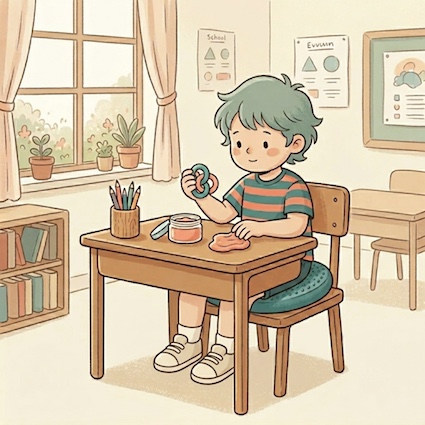
Which fidget tools are realistically allowed in a UK classroom, which ones get confiscated, and how to get one agreed with the teacher in advance.
The most useful thing I've learned about the run-up to a new term is that preparation works better front-loaded into the adult end of the job and back-loaded into the child's. The buying, messaging and organising can all happen early without your child having to think about school at all. The rehearsal happens close enough to the first day that it still means something.
No school talk, no preparation, nothing resembling a demand. This stretch is for coming down from the term that just finished.
Uniform bought and washed, equipment ordered, message to school sent. All of it invisible to your child.
Uniform worn for short stretches, visual timetable made, a walk past the school gates, sleep starting to shift.
Morning routine practised in miniature, bag packed early, first-day plan agreed and written down.
The first phase is the one parents skip, and skipping it costs more than it saves. A child who has just finished a full term is usually running on empty, and the days immediately afterwards are when that comes out, often as irritability, clinginess, or hours of the same programme on repeat. That isn't regression, it's recovery, and pushing preparation into it makes the return harder rather than easier.
Closer in, familiarity is the thing you're buying. A photo of the new teacher, a walk to the school gates on a quiet afternoon, the uniform worn for twenty minutes, the new lunchbox used at home once. None of it removes the uncertainty, but it converts one large unknown into several smaller known things. Sleep is worth moving in ten to fifteen minute steps across the final fortnight rather than one large correction the night before, and morning light matters as much as bedtime.
If you're reading this with days rather than weeks to go, two things matter more than the rest: get a short message to school about what helps, and get the uniform on your child at least once before the first morning. Everything else can follow in the first fortnight.
The year that went best for us wasn't the one where I did the most preparing. It was the one where I did all the boring parts early and then left the last fortnight almost empty.
The pattern I hear most often, and the one I've watched in my own house, is that the first week back goes surprisingly well and the second week doesn't. Novelty carries a lot of children through the first few days. Everything is new, the adults are watchful, expectations are lower and the timetable is loose. By week two the attention has moved on, the work has started properly, and the effort of holding it together has been accumulating for eight or nine days.
What that looks like at home is often after-school restraint collapse: a child who was reportedly fine all day falling apart within minutes of getting through the front door. It's a sign that school took everything they had, not that home is the problem. It also helps to know the difference between a meltdown and a shutdown, because the quiet version is easily mistaken for a child who is coping.
Protect the first two weekends of any new term. It isn't the moment to add clubs, parties or trips. Reducing everything outside school for a fortnight gives a child room to absorb the change, and it's far easier than clawing the time back once things have already gone wrong.
The after-school hour is worth planning like any other part of the day. Food first, no questions for the first half hour, and something reliably regulating: a bath, the trampoline, a dark quiet room, whatever already works. Questions about how the day went land better at bedtime than at the school gate, if they land at all.
Most children settle within three or four weeks. If your child is still distressed a month in, or the mornings are getting worse rather than better, treat that as information rather than waiting longer. Reluctance that escalates into genuine inability to get through the school door has a pattern to it, and it's much easier to address early. My guide to school anxiety and school refusal covers what tends to be underneath it and what to ask school for.
Escalating sensory difficulty is worth raising as its own issue rather than folding it into a general conversation about behaviour, particularly if the classroom environment has changed. My guide to sensory overload is a useful thing to send to a teacher who hasn't come across it before.
For advice that goes beyond what school will tell you, IPSEA (ipsea.org.uk) provides free legally based advice on SEN support and EHCPs, and your local SENDIASS service offers free impartial support to parents. Both are worth contacting before a situation becomes formal rather than after.
Why a child who was reportedly fine all day falls apart at 3.30, and what helps in the first hour at home during the hardest weeks of a term.
What parents ask most often about going back to school.