Related guide
Proprioception & the Vestibular Sense
Interoception sits alongside proprioception and the vestibular sense as one of three hidden senses that shape how neurodivergent children experience the world.
Why your child doesn't notice they're hungry, can't tell when they need the toilet, or melts down without warning. And what the 8th sense has to do with it.
I'm a parent, not a clinician. This guide draws on peer-reviewed research, publications from occupational therapist Kelly Mahler (the leading researcher in this field), NHS trust resources, and the Lurie Center for Autism at Harvard Medical School. It is not clinical advice. If you think your child has significant interoceptive differences, speak to your GP or SENCO about a referral to a paediatric occupational therapist.
For years, we talked about Ella's hunger as a behaviour problem. She would refuse breakfast, then melt down before lunch, then insist she wasn't hungry at dinner. We tried timers, sticker charts, reward systems. None of it touched the sides. The problem wasn't behaviour. She genuinely couldn't feel hungry. Or rather, she couldn't interpret the signals her body was sending her. Her interoceptive system processes information differently, and that one difference has ripples through almost everything.
Interoception is one of those concepts that, once you know it, you start seeing it everywhere. It explains so many things that can look like refusal, defiance, or emotional dysregulation in neurodivergent children. It's also still relatively unknown outside occupational therapy circles, which means a lot of families spend years addressing symptoms without ever reaching the underlying cause.
Interoception is the sensory system that tells you what is happening inside your body. While the other senses gather information from the outside world (what you see, hear, smell, taste, and touch), interoception gathers information from within: from your organs, tissues, muscles, and skin.
It registers hunger and fullness, thirst, the need for the toilet, pain, body temperature, fatigue, nausea, a racing heart, and tight chest. Crucially, it also registers the physical sensations that underlie emotions: the flutter of anxiety, the heaviness of sadness, the heat of anger, the lightness of joy. Receptors throughout the body send these signals to the brain via the insular cortex, where they are processed and turned into conscious awareness.
Occupational therapist Kelly Mahler, whose research is the canonical reference for interoception in autism and ADHD, describes it as "the ability to notice, interpret, and act on our internal physical sensations." She notes that interoception underpins not just physical needs but emotional awareness, decision-making, empathy, and self-regulation, making it one of the most consequential sensory systems for daily life.
You sometimes see it called "the 8th sense." The original count of five senses has grown over the decades to include proprioception (body position), the vestibular sense (balance and movement), and now interoception, and it may well be the one with the widest reach.
Research has found higher rates of interoceptive differences in autistic people and those with ADHD compared to neurotypical peers. A 2019 study published in the Journal of Autism and Developmental Disorders found that children with autism showed poorer interoceptive accuracy than matched neurotypical controls. NHS sensory processing resources, including Sheffield Children's NHS Trust, list interoception as one of the senses commonly affected in children with sensory processing differences.
The reasons are not yet fully understood, but differences in insular cortex function are thought to play a central role: the insular cortex is responsible for processing interoceptive signals, and it is an area where neurological differences have been observed in autistic brains.
Interoception is also closely linked to alexithymia: difficulty identifying, describing, and understanding one's own emotions. Alexithymia is distinct from autism but affects around 50% of autistic people. Because emotions are partly registered as physical sensations in the body, poor interoceptive awareness can make it significantly harder to know what you are feeling, even when the emotion is there. A child who says "I don't know" when asked how they feel is very often telling the truth — they cannot access that information reliably.
Autistic children who also have ADHD (sometimes called AuDHD) can face a compounding challenge: ADHD affects attentional resources, and interoception requires attention directed inward. Jude, for instance, is so externally focused that body signals often don't break through until they become urgent.
My guide to AuDHD covers the wider picture: how common the overlap is, why the two conditions mask each other, and how the traits pull in opposite directions.

Interoception sits alongside proprioception and the vestibular sense as one of three hidden senses that shape how neurodivergent children experience the world.
These signs are common in children with interoceptive differences. They can look like stubbornness, inattention, or emotional volatility. But each one reflects a real difficulty reading the body's internal signals.
Never says they are hungry, or forgets to eat entirely. Alternatively, doesn't notice fullness and keeps eating past the point of comfort.
Doesn't notice the urge to use the toilet until it is urgent or too late. This is a physiological signal-detection issue, not a behaviour problem or regression.
Forgets to drink throughout the day, doesn't ask for water, and may not feel thirst even when significantly dehydrated.
Refuses to wear a coat in winter, or keeps a coat on indoors in summer. May not notice they are shivering, sweating, or overheating.
Because internal signals of stress or overwhelm aren't being read clearly, there are no early warning signs. By the time the child notices something is wrong, they are already in crisis.
Genuinely cannot identify emotions when asked. Not withholding: they cannot access the internal data that would let them answer the question.
Resists bedtime and insists they are not tired, even when visibly exhausted. May not feel the signals of fatigue clearly enough to interpret them as "I need to sleep."
Doesn't notice or doesn't report minor injuries. May seem impervious to pain that other children would find distressing, or conversely, may over-report low-intensity sensations.
"Ella's OT described it to me like this: imagine someone kept turning the volume down on all your body's internal radio stations. You'd miss a lot of the signals you normally use to navigate the day. That's what interoception difficulties can feel like. It reframed so much of what I'd been seeing, and a lot of what I'd been getting frustrated about, in a completely different way."
The day-to-day signs above are disruptive enough on their own. But interoception has reach into areas that aren't always connected to it in the parent guides and SEN resources you come across.
Emotional regulation. Because emotions are partly registered as physical sensations (a tight throat before crying, a hollow stomach before anxiety peaks), children who don't read interoceptive signals clearly often struggle to regulate their emotions. They can't feel the early warnings that would let them take action before things escalate. This is why so many of the strategies in the Zones of Regulation begin with body-scanning exercises: the goal is to build interoceptive awareness so the child can notice they are moving into Yellow before they are already in Red.
Safety awareness. Interoception helps us notice when something is wrong in the body: a full bladder before it becomes urgent, pain before it becomes unbearable, illness before it peaks. Children with significant interoceptive differences can miss these signals in ways that create genuine safety concerns: not registering pain from an injury, or not noticing they are severely dehydrated.
Social understanding. Kelly Mahler's research highlights an often-overlooked connection: the same internal signals that help us understand our own emotional states are used in empathy, to simulate what another person might be feeling. Interoceptive differences can therefore affect social cognition in ways that look like lack of empathy but are better understood as difficulty reading internal signal data, in oneself or, by extension, in others.
Self-care and independence. As children grow older, the ability to notice hunger, manage toilet needs, recognise tiredness, and identify illness becomes foundational to independence. Interoceptive support in childhood is partly about the present, and partly about building the internal awareness these children will need as adults. If toilet training itself is the immediate struggle, my guide to toileting and autism covers the physical and sensory factors in more depth.
The encouraging finding from research is that interoceptive awareness is not fixed. It can be developed with the right approach. The key is that you cannot force a child to notice body signals. But you can create conditions where it becomes easier and more natural to tune in.
The work of Kelly Mahler, an occupational therapist and Doctor of OT at Elizabethtown College, is the primary evidence base here. Her Interoception Curriculum is a structured programme used in schools and clinical settings. A feasibility study published in Occupational Therapy in Health Care (2024) found statistically significant improvements in interoceptive awareness and emotional regulation after a 7-week intervention with children in a special education classroom. An earlier pilot study (Hample, Mahler & Amspacher, 2020) found similar improvements in children with autism following an 8-week programme.
You don't need the formal curriculum to support interoception at home, but the principles matter:
At neutral moments (not during distress), gently draw attention to what is happening in the body. "What does your tummy feel like right now?" "Can you feel your heart beating?" The goal is noticing, not labelling. There is no wrong answer. Over time, this builds the habit of attending to internal signals.
Use an outline of a body and ask your child to colour or mark where they feel different things: where does "excited" live? Where does "tired" show up? This externalises internal data in a way that suits many visual thinkers. It is also a useful communication tool for non-speaking or minimally verbal children.
Rather than waiting for your child to notice they are hungry or need the toilet, build external scaffolding: structured meal and snack times, toilet reminders at set intervals, and regular drink breaks. This bypasses the unreliable internal signal system while reducing the risk of missed needs escalating into distress.
Activities that increase heart rate, breathing, or physical sensation (running, jumping, yoga, swimming) make interoceptive signals stronger and therefore easier to notice. A mini trampoline is one of the most accessible ways to create this kind of heightened internal body awareness at home.
When you notice your child is flushed, fidgeting, or slumping, name what you observe in physical terms rather than emotional ones: "Your face looks hot" rather than "You seem angry." This helps build the bridge between sensation and meaning without putting pressure on the child to identify an emotion they may not be able to access.
Breath is one of the clearest interoceptive signals, and one of the few that can be both noticed and deliberately changed. Simple breathing exercises, particularly extended exhale techniques (breathing out for longer than you breathe in), help children practise tuning into a body signal while also having a calming physiological effect.
If interoceptive differences are significantly affecting your child's daily life, particularly toileting, eating, emotional regulation, or safety, it is worth asking for a referral to a paediatric occupational therapist. Your GP or SENCO can make this referral. An OT can carry out a sensory profile assessment that includes interoception, and can recommend a tailored programme of activities based on your child's specific profile.
NHS waiting times for paediatric OT vary significantly by area. If the NHS wait is long and the difficulties are urgent, some families access OT privately while waiting. RCOT (the Royal College of Occupational Therapists) has a therapist finder at rcot.co.uk.
If your child is already in school with SEN Support or an EHCP, interoception support can be included in a sensory diet, written into provision, and delivered or overseen by a school's OT where one is available. A Sensory Profile is a useful starting point for sharing your child's interoceptive needs with school.
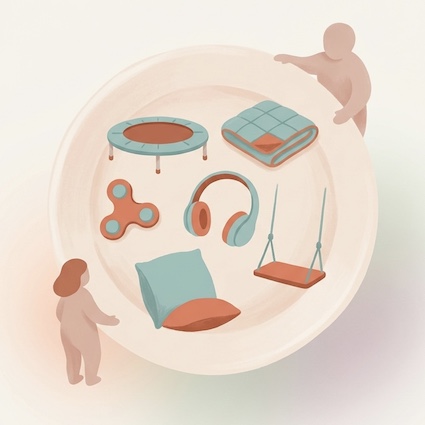
Interoception activities can be built into a sensory diet alongside proprioceptive and vestibular input for a joined-up approach to sensory regulation.
Questions parents ask most often about interoception.