Related Guide
Meltdowns vs Shutdowns
When regulation breaks down completely, what's happening neurologically, how to tell a meltdown from a shutdown, and what helps in the moment.
What emotional regulation really means for a neurodivergent child, how the Zones framework is used in UK schools, and how to build a regulation kit at home that actually gets used.
I'm a parent, not an occupational therapist. A bit more about me here. This guide draws on the published work of Leah Kuypers (Zones of Regulation), Kelly Mahler (interoception research), and UK sources including the National Autistic Society, ADHD UK, YoungMinds, and the Anna Freud Centre. The Zones of Regulation curriculum is a copyrighted programme; this guide is a parent-facing overview and is not a substitute for the official materials, school-led teaching, or specialist support.
If your child is in a UK primary school, there is a good chance they have already met the Zones of Regulation. Most schools that work with neurodivergent children use it, and most parents first hear about it at a class meeting, an EHCP review, or in a "your child went into Red today" message on the home-school app. Almost none of those first encounters come with a proper explanation of what the framework is, what it is not, and how to support it at home. If those school conversations are on the horizon, my School Meetings & Communication Pack includes meeting prep sheets and follow-up templates for keeping them on track.
This guide is an attempt to fix that. It covers what emotional regulation really is, why it tends to be harder for autistic and ADHD children, and how the Zones of Regulation framework fits into the wider picture. It also explains how to build a small, practical regulation kit at home, and what to do when regulation breaks down into a meltdown or shutdown. Both my children sit somewhere on the regulation map most days, and my own adult-diagnosed ADHD means I'm not exactly a neutral observer.
Emotional regulation is the ability to notice what you're feeling, work out what's causing it, and respond in a way that fits the situation you're in. That is the whole definition. Notice the things it doesn't include: it doesn't include hiding the feeling, suppressing it, or always staying calm. A well-regulated child can be sad, furious, excited, or overwhelmed and still function. The point is not the absence of strong emotion. The point is being able to ride it without coming off the rails.
Regulation is a developmental skill that takes a long time to build. Most neurotypical children spend the years between three and adolescence slowly moving from being regulated by an adult (co-regulation) to regulating themselves (self-regulation). Even then, most adults still rely on co-regulation more than they like to admit. A bad day fixed by a friend's text message is co-regulation. A panicky moment soothed by your partner's voice is co-regulation. The instinct to call your mum when something goes wrong is co-regulation. We don't grow out of needing other people to help us settle. We just get better at hiding that we do.
The headline: Self-regulation grows out of co-regulation. A child who has never been reliably co-regulated does not learn to self-regulate. They learn to suppress, to mask, or to explode. Neither suppression nor explosion is regulation.
This matters because much of the advice given to parents of neurodivergent children, particularly older ones, assumes they should already be able to self-regulate. They often can't. Not because they're behind. Because their regulation development runs on a different timeline and needs longer, more consistent co-regulation from the adults around them. The Anna Freud Centre and most current UK child mental health guidance is now explicit about this. Co-regulation is the foundation. There is no shortcut.
Regulation difficulties are one of the most consistent threads across autism, ADHD, and the broader sensory profile. The reasons stack up, and most parents don't see all of them at once.
Where both are present, regulation gets harder rather than averaging out, because the two sets of needs frequently conflict. My guide to AuDHD covers that push and pull.
Interoception is often less reliable. Interoception is the sense of what's happening inside the body: hunger, thirst, tiredness, needing the toilet, racing heart, the felt sense of an emotion. Kelly Mahler's research has put this at the centre of regulation thinking in the last decade. A child whose interoception is unreliable doesn't get the early-warning signal that they are getting hot, hungry, or anxious. The first they know of it is when the wave is already breaking. By then it's too late to use a strategy. This is also why so many neurodivergent children skip lunch at school and fall apart at 4pm, or refuse a drink all day and then have a meltdown that turns out to be dehydration. Interoception belongs in the same conversation as proprioception and the vestibular sense as one of the hidden sensory systems most parents have never had explained.
Sensory load is higher. If your child is already managing scratchy clothes, fluorescent lights, the smell of the canteen, the noise of the corridor, and the unpredictability of break-time, they are using regulation capacity to cope with all of that before any feeling has even arrived. Sensory overload is often the underlying state that tips a child out of regulation, and it is constantly underestimated by adults who aren't sensory-sensitive themselves.
Executive function differences make it harder to pause and choose. Regulation in the moment requires noticing the feeling, deciding which strategy to use, remembering where the tool is, going to get it, and using it. Each of those steps is an executive function task. For an ADHD child in particular, the gap between feeling and action can be very small. There isn't always a moment to pause.
Masking through the day burns through capacity. Children who are masking at school are doing a regulation task continuously for six hours. By the time they get home, the capacity is gone. This is the mechanism behind after-school restraint collapse and is one of the most common parent complaints I hear: "she's fine at school and impossible at home." She is not impossible at home. She has run out of regulation capacity to spend.
"Ella will sometimes burst into tears at 4.30pm over a biscuit being the wrong shape. Two years ago I would have got annoyed. Now I know what it is. The biscuit is not the problem. The biscuit is what finally arrives at the door of a nervous system that has been holding the line all day. The biscuit is just the bit she can put words to."
This is the single most important idea in the whole topic, and most "calm down corner" advice gets it backwards. Self-regulation is a skill that grows out of years of being co-regulated. A two-year-old learns to soothe themselves because they have been soothed thousands of times by a calm adult. A nine-year-old has not yet finished that process. A nine-year-old neurodivergent child is often a long way from finishing it.
Co-regulation means a calm adult lending their settled nervous system to a dysregulated child. Practically, this looks like: lowering your voice when theirs goes up, slowing your movements when theirs speed up, getting physically close without crowding, breathing slowly enough that they can feel it. It is not a script. It is a state. If your own nervous system is also activated, you can't co-regulate; you'll escalate. Walking away briefly to settle yourself first is co-regulation work. It is not abandonment.
The order matters. Connect first. Regulate together. Reflect later. Skipping straight to "what could you have done differently?" while the child is still in a heightened state doesn't teach them anything. They aren't online yet. The conversation is for after.
For neurodivergent children, the timeline for being able to self-regulate without an adult nearby often stretches well into adolescence and sometimes beyond. That is not a problem to fix. It is a fact to plan around. Expecting a seven-year-old autistic child to use a "calming strategy" in their bedroom independently while you're downstairs is asking for a skill they haven't built yet. Co-regulate, model the strategy alongside them, do it together fifty times, and the independent use comes later.
The Zones of Regulation is a curriculum developed by Leah Kuypers, a US occupational therapist, to give children a shared vocabulary for noticing how they feel. It groups internal states into four colour-coded zones. The framework is widely used in UK schools, particularly primary schools and special schools, because it gives staff and children a simple way to talk about regulation without using complicated language. The official curriculum, materials, and teaching resources are at zonesofregulation.com.
The four zones, in plain parent English:
Tired, sad, bored, unwell, withdrawn. Energy is low. The body wants to slow down or shut off.
What helps: gentle alerting input, warmth, comfort, a snack, sometimes rest.
Focused, content, settled. Not blank, not flat. The state in which learning and connection happen.
What helps: noticing it. Most children don't realise Green is something to recognise.
Heightened, anxious, silly, frustrated, excited. Still in control, but the dial is going up.
What helps: calming or heavy-work input, a quiet break, a tool they know.
Out of control, panicking, raging, frozen. The nervous system has gone into emergency.
What helps: co-regulation. Safety. Lower input. Strategies don't land here.
A few things to understand about how Zones is meant to work in practice, because a lot of schools apply it badly and a lot of parents inherit the misunderstanding.
It's a description, not a judgement. The Blue Zone isn't sad-and-therefore-bad. The Red Zone isn't naughty. Yellow isn't "warning, behave yourself." Each zone describes an internal state. All four are legitimate human experiences. The job of regulation isn't to stay in Green; it's to notice the zone and use a tool that fits.
The Red Zone is not a behaviour problem. A child in the Red Zone is dysregulated. They are not making a choice. Treating Red as misbehaviour by issuing consequences, removing privileges, or sending them to a "thinking spot" is one of the most common school mistakes. The correct response to Red is co-regulation and lowered demands, which is what the framework says when read carefully, even if many staff have never been trained in it properly.
The aim is awareness, not constant Green. A child who only ever spends time in Green is suppressing or masking. The point of Zones is the noticing, not the result. "I'm in Yellow right now and I think I need a fidget" is success. "I'm fine, I'm fine, I'm fine" with a tight jaw is not.
The misuse to watch for: Some classrooms use Zones charts as a behaviour management tool, asking children to display their zone publicly or losing rewards when they move out of Green. That isn't the framework. That's the framework being used as a compliance system, which is the opposite of what it's for, and for an autistic or PDA child it can be actively harmful.
If your child is being taught Zones at school, the teaching usually includes: posters in the classroom showing the four colours, lessons explaining what each zone feels like, a vocabulary of tools matched to each zone, and (in some schools) a chart or card where the child indicates their zone at key points in the day. The aim is for the language to become so familiar that the child can use it under pressure without having to translate.
Some schools also use individual "regulation plans" or "calm boxes" with a small selection of agreed strategies and tools. These work well when the child has been involved in choosing what goes in the box and has practised using the items when calm. They work badly when the box appears only at the moment of crisis or when the child has never been shown how to use what's inside.
If your child has an EHCP or sits on SEN support, regulation strategies will often be written into the plan: things like access to a quiet space, agreed signals to leave the classroom, sensory breaks, or a key adult to check in with. These provisions only work if the child knows about them in advance and feels safe to use them without judgement.
If you want to understand how your child's school is using the framework, useful questions for the SENCO or class teacher are: which version of Zones are you teaching, what tools have you matched to each zone, how does my child indicate they need a break, what happens when they go into Red, and is there a parent handout I can have? Schools that use Zones well will have ready answers. Schools that put up the posters but don't really teach it tend to be vague, and that vagueness is a useful signal in itself.
The point of a regulation kit is to have a small, agreed set of strategies that your child can reach for when they notice their zone shifting. It doesn't need to be elaborate. Eight or ten well-practised tools beat fifty unfamiliar ones. The kit needs three categories.
Lower the dial. Reduce sensory input. Slow the nervous system down.
Raise the dial. Wake the body up. Help a flat child come back online.
Proprioceptive input is the regulator that works in both directions. It calms a hot system and wakes a flat one.
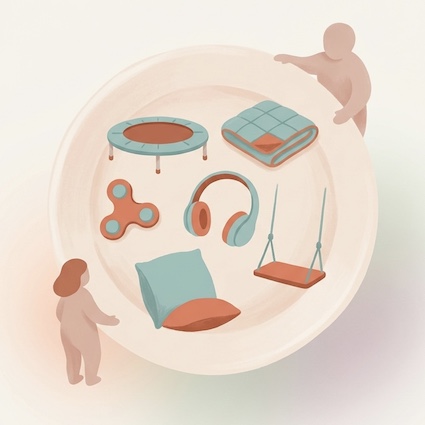
For the specific calming category, the products that come up most often in our house and in conversations with other SEN parents are a weighted blanket on the sofa, a weighted lap pad on the dining table, a sensory tent as a self-chosen retreat, ear defenders within reach for noise spikes, and a chew necklace for the children whose calming comes through oral input. None of these tools regulate on their own. They are scaffolding for a child who is learning to notice and respond to their state.
For the heavy work and alerting categories, a mini trampoline earns its keep most days in our house, and fidget toys and therapy putty are useful for the in-between moments. The wider conversation about matching sensory input to regulation need is the sensory diet conversation, which sits alongside Zones rather than replacing it.
The kit only works if: the child has practised the tools when calm, knows where they are without asking, and is allowed to use them freely without earning them. Tools that have to be requested or rationed become demands themselves and lose their regulating effect.
Morning: Jude wakes up tired but okay. Green Zone. Breakfast, school run, classroom. He uses a wobble cushion and a small fidget in class. So far, holding it together.
Lunchtime: the canteen is loud. He eats half his sandwich. Interoception isn't telling him he's still hungry. He drifts toward Yellow but doesn't have language for it. The teaching assistant notices he's bouncier than usual and lets him do five minutes of star jumps in the corridor. That heavy work brings him back to Green for one more lesson.
End of day: the cumulative load has stacked up. He's in Yellow when I collect him but presenting as Green because he's masking. In the car, the radio is on. Wrong song. Eruption. He's in Red within ninety seconds.
What I do: radio off. I don't speak for a minute. I put my hand on his shoulder. We sit in the school car park. After three or four minutes, his breathing slows. I don't ask what happened. I say, "rough afternoon, mate. Home now." He gets in the front seat for a change. We drive home in silence. The biscuit-related explosion at 4.30pm is, by then, a fifty percent chance rather than a certainty.
What I don't do: ask him to explain what happened. Suggest a strategy. Tell him to calm down. Promise consequences. Reach for any of the Yellow Zone tools because we are past Yellow and they don't work here. The Red Zone wants co-regulation and very low input. Everything else is for later.
Some of these are mine, some are from watching other families, and most are baked into the way the framework gets implemented in UK schools.
Tracking which zone a child is in and rewarding Green or punishing Red turns the framework into a compliance system. It teaches the child to lie about how they feel. That is the opposite of regulation.
"Go to your calm corner and use a strategy" is asking for the end product before the foundations are built. Co-regulate with the child fifty times first. The independent use comes later.
A child in the Red Zone is not online for conversation. Words, questions, and explanations add input to a system that already has too much. Quiet presence is what helps.
All four zones are legitimate. A child who is "in Green" all the time is probably masking. Yellow is fine. Blue is fine. The point is to notice and to respond, not to live in Green.
Tools that only appear when the child is dysregulated never get learned. Use them when calm. Use them often. Let them become familiar before they have to do real work.
You can't co-regulate from Yellow yourself. Most parents I know, including me, have had to learn to manage their own state first. There is no shame in walking out of the room for thirty seconds to breathe.
Sometimes the dial moves so fast that nothing in the kit gets a chance. The child is in the Red Zone before anyone, including them, has spotted Yellow. This is when regulation becomes a meltdown (outward) or a shutdown (inward), and at this point you are no longer in regulation territory; you are in crisis-response territory. The strategies are different.
Make sure the child and anyone nearby are physically safe. Move sharp objects if you need to. Don't try to teach in the middle of a meltdown. The brain is offline.
Voices, lights, movement, expectations: all of these add to the load. Dim the room, send siblings out, switch the music off, sit down rather than stand over them.
For most children, a calm adult within reach is grounding. For some, particularly those who go into shutdown, physical proximity feels like more demand. Read the child and adjust. Stay close enough to be available, not close enough to be felt as pressure.
Most meltdowns and shutdowns last between five and forty minutes. The body cannot stay in fight-or-flight indefinitely. The wave does pass, even when it feels like it won't. Your job is to be there when it does.
After a Red Zone episode, the child often slides into the Blue Zone for hours or even the rest of the day. Tired, flat, sometimes tearful or quiet. This is not them being difficult. This is the nervous system recovering. Don't pile on demands. Soft food, low light, quiet company.
Reconnect first: a shared snack, a film, sitting together without talking. Only much later, sometimes the next day, ask gently what was happening. And only if the child wants to. Not every meltdown needs a debrief. Some are best left where they fell.
One of the things that makes regulation work easier is when home and school use the same words. If the school is teaching Zones, learning to use the same colours at home means your child doesn't have to translate between settings. "Are you in Yellow right now?" lands faster than "are you starting to feel a bit wobbly?" because the language has already been built at school.
Practical asks for school, if the conversation is open: a copy of any parent handout, a list of the tools used in the classroom, a note in the home-school book or app when your child has moved zones in the day (so you can match the support at home), and an agreed signal your child can use to ask for a break without having to speak. The best SEN provision I've seen for regulation is a small laminated card the child can put on the teacher's desk that means "I need a break" without having to negotiate it out loud.
If the school isn't using Zones and you don't want to push for it, you can still use the framework at home. The colours work just as well in one setting as in two. The advantage of a shared language is reduced load on the child, not the framework itself. Pick a vocabulary, use it consistently, and stick with it for long enough that it becomes second nature.
The framework gives children a vocabulary and a structure. It does not regulate anyone on its own. A child whose nervous system is under chronic load from sensory overwhelm, an unmet sensory diet, sleep deprivation, school anxiety, or a placement that doesn't fit their needs is going to keep cycling through the zones regardless of how well they can name them. The Zones of Regulation is not a substitute for the wider work of meeting the child's needs. It is a useful piece of vocabulary inside that bigger picture.
I have also met families whose autistic or PDA child finds the framework itself unhelpful — too prescriptive, too school-flavoured, too like another set of rules. That is also fine. The framework is a tool, not a requirement. If your child responds to it, use it. If they don't, the underlying ideas (notice the state, co-regulate, match the tool to the need) still apply without the colours.



The things that come up most often when families first meet the Zones framework.