Noise & Sound
Best Noise-Cancelling Headphones
for Children & Teens
For sensory-sensitive children who need more than passive protection. Wireless, volume-limited, and actually comfortable to wear.
For sensory-sensitive children who need more than passive protection. Wireless, volume-limited, and actually comfortable to wear.
"Ella still uses her ear defenders day-to-day, but when Jude hit the age where bright ear defenders suddenly felt babyish, and he needed something he could actually wear without standing out, the JBL Junior 470 NC was the one that ticked every box. Safe volume, decent ANC, and he'll keep it on."
— Sarah M., founder of Sensory Sorted
There's a point, usually around age nine or ten, when a child who's been happily wearing bright-coloured ear defenders suddenly won't be seen dead in them. The protection need doesn't go away; the tolerance for looking different does. Noise-cancelling headphones fill that gap, and they do more than passive defenders in some situations. Active noise cancellation handles constant background drone better than physical blocking alone — engine noise on a school minibus, the hum of a busy classroom, the relentless noise of a supermarket. They're not a straight swap for ear defenders, and they're not right for every child, but for older sensory-sensitive children and teens, the right pair can make a real difference. The five on this page are the ones I'd actually consider. I'm a parent, not an audiologist, and as always I've verified all prices, ratings, and specs directly from Amazon before writing.
Five picks across a range of ages, budgets, and needs.

JBL is one of the few mainstream audio brands that has put genuine thought into the children's version of its headphones rather than just scaling down an adult pair. The 85dB volume cap is built in by default, with parental controls via the JBL Headphones app letting you monitor usage and volume in real time, useful if your child tends to crank things up. Active noise cancellation blocks background distraction well, which is particularly helpful for children who find auditory overload in busy environments exhausting. The cushioned headband has a 12mm soft pad, comfortable enough for extended wear, and 50 hours of battery means you won't be hunting for a charger mid-week. A 5-minute USB-C fast charge gives another 3 hours, which covers the morning rush. The built-in microphone means it works for calls and voice assistants without swapping headsets. Available in pink, and white and grey. The sticker set is a small but genuinely child-friendly touch.

The Philips K5500 has a feature you won't find on most headphones: two pairs can pair to the same device and share audio together. For siblings, for car journeys, for children who process things better with a co-listener alongside them, that's a genuinely useful function. The volume control is tiered: 75dB by default in quiet settings, stepping up to 85dB via the app for noisier places, so parents have control without fuss. Adaptive Noise Cancellation adjusts to surroundings rather than applying fixed ANC, which tends to feel less pressure-heavy. Awareness Mode and Quick Awareness let the child hear voices or announcements without pulling the headphones off, helpful for children who struggle with unexpected transitions or instructions. Battery life is impressive at 60 hours with ANC off, 34 hours with ANC on. Available in real teal and blue.

If your child is younger, school reception age upward, the iClever BTH19 is worth a look. It is explicitly designed for children from age 3, with BPA and PVC-free materials, 90° rotatable earcups, and a 10-level adjustable headband. What sets it apart for sensory children specifically is the dual ANC setting: a low mode for children who find the pressure sensation of active noise cancellation uncomfortable, and a high mode that blocks most mechanical background noise. That distinction matters. Some children find full ANC disorientating rather than helpful, and having a gentler option is a real practical advantage. The volume cap is 80dB using iClever's Sound Refiner technology, which also targets the 2kHz–4kHz range most likely to cause hearing damage. Battery runs to 60 hours (ANC off) or 35 hours (ANC on), and a 10-minute Type-C charge gives 5 hours. Available in multiple colour combinations. Wired mode works without battery charge, which is a useful backup.

The Tonoshark is a budget option that punches reasonably well for the price. The silicone carry case is a standout practical detail: it doubles as a small bag and makes the headphones far easier to manage in a school bag or on a journey. The nylon braided cable is tangle-free and noticeably more durable than the thin cables that come with cheaper alternatives. Bluetooth 5.3 gives a stable connection, and the headband is adjustable PC construction designed to resist stretching. ANC is included and works for standard background noise reduction. It won't match JBL or Philips on refinement, but for a family that needs a functional noise-cancelling option without spending £60+, it delivers. Available in blue and red, blue and purple, purple, dark blue and pink. The included carry case is something the pricier options could learn from.
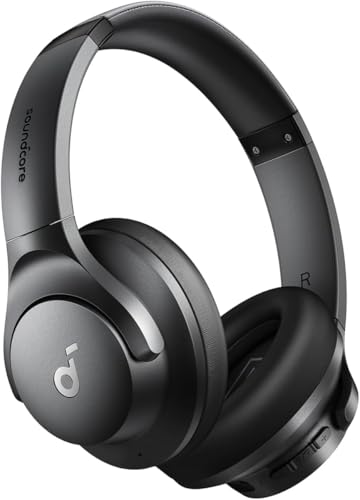
The Soundcore Q20i isn't a children's headphone. It's an adult model, included here because it regularly comes up when parents of older teens are searching, and it's genuinely worth the recommendation for that age group. Four built-in microphones for ANC, 40 hours of battery with ANC on (most children's headphones quote their best figure without ANC running), and multipoint connection that switches automatically between phone and laptop. Transparency Mode is well implemented, allowing ambient sound through clearly when needed. The soundcore app adds EQ customisation, custom white noise profiles, and AI translation between over 100 languages, a niche feature that some neurodivergent adults find practically useful in situations where processing spoken language is harder. No volume cap, which is the trade-off. Available in black, white, blue, and pink. Worth considering for secondary school age and upward, particularly for students who spend long hours studying.
Questions parents ask most about noise-cancelling headphones for sensory children.