Sensory Tools
The best sensory crash mats for big energy, safe landings
For children who need to jump, crash, and collide, a crash mat gives them somewhere safe to do it. Five foam landing pads worth considering for sensory seekers at home.
Written by Sarah M.
Contains affiliate links
Updated April 2026
⭐ Sarah's Top Pick
"Jude has always been a crasher. Sofa cushions on the floor, rolling into things on purpose, launching himself at me from the stairs, that full-body impact is just something his body needs. The SaferBounce mat has changed things at home. It lives in the corner of the playroom and he goes to it like it's his job. It absorbs everything he throws at it, the cover comes off in the wash, and it's solid enough that it's not going anywhere when he lands on it. Honestly one of the most-used things we've ever bought."
— Sarah M., reviewing the SaferBounce Sensory Crash Pad
A crash mat is, at first glance, an oddly literal piece of equipment, a cushion designed to be jumped on. The reason it works is buried in the way some children's nervous systems are wired: sensory-seeking kids need intense proprioceptive input to feel regulated, and crashing provides exactly that — deep, full-body, predictable feedback that calms the system rather than escalating it. Jude has been a crasher since he was tiny. I'm a parent, not a paediatric OT. Having a dedicated mat in the corner of the playroom has reduced the number of times he launches himself off the sofa, off me, or into doorframes by a significant margin. It's particularly useful during after-school restraint collapse, when six hours of holding it together at school turns into pure physical energy that has to land somewhere. For children with ADHD or autism whose body is constantly looking for impact, a crash mat is one of the most useful single purchases a family can make.
Five mats built for actual crashing
Five crash mats worth looking at, from compact home options to larger sensory room pads. All checked for quality, foam density, and UK availability on Amazon.
★ Top Pick
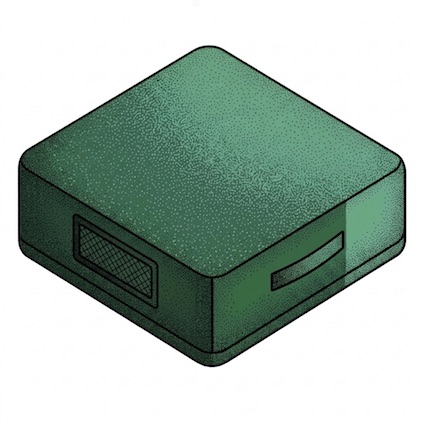
The SaferBounce sits at the top of the list for a reason, that 4.8-star rating with a meaningful volume of reviews is hard to argue with, and our experience backs it up. This is a purposefully designed sensory crash pad: thick, high-density foam that absorbs impact properly rather than bottoming out on a hard floor, a removable cover that comes off and goes straight in the machine, and dimensions (122 x 91 cm) that make it usable as a landing area without requiring a dedicated room. Jude uses ours daily. The foam holds its shape well, it doesn't move around on the floor when he lands on it, and the cover has survived more washing cycles than I'd care to count. If your child is a regular crasher and you want one mat that will last, this is where I'd start.
Pros
- Highest-rated option on this list
- Purposefully designed for sensory use
- High-density foam holds its shape
- Removable, machine-washable cover
- Good size for home use
Cons
- Higher price point
- Available in one size (S/122 x 91 cm): less flexible than adjustable options
Check Price on Amazon →
#2
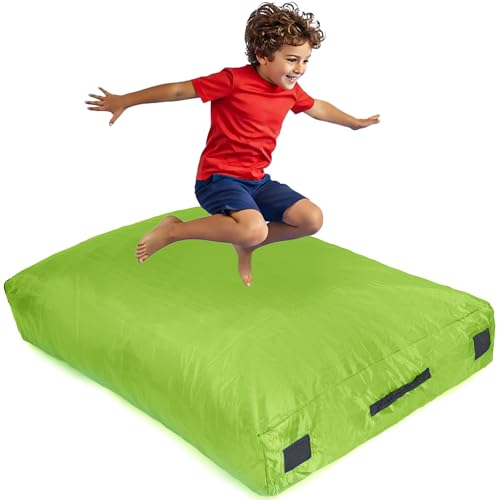
ODOXIA have built a solid reputation in the UK sensory market — their compression sheets and tunnels appear elsewhere on this site, and their crash pad is equally well made. What sets this one apart is the size choice: you can opt for the standard 122 x 91 cm or go up to a large 152 x 152 cm square. The bigger size is particularly useful if you have more than one child who'll use it, or if your child likes rolling across the surface rather than just landing in one spot. The foam is high-density, the cover is removable and machine washable, and the quality feels consistent with the rest of the ODOXIA range. For the price range, this is excellent value, particularly at the lower end of the price window.
Pros
- Choice of two sizes including very large 152 x 152 cm
- Trusted UK sensory brand
- Good value across the price range
- Removable, machine-washable cover
Cons
- Larger size significantly increases the price
- Slightly lower rated than the SaferBounce
Check Price on Amazon →
#3
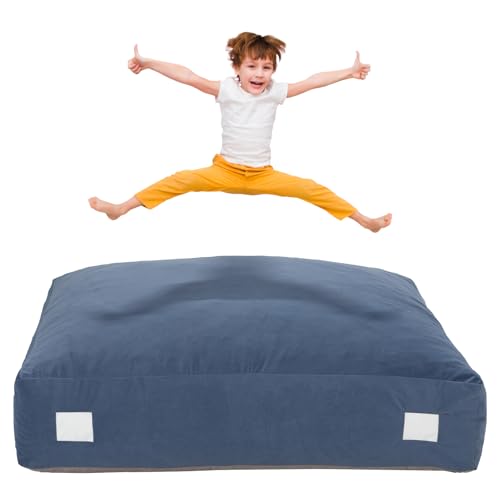
The Whiffee earns its place here on the strength of a few practical features that the others don't have. The anti-slip base is genuinely useful — crash mats on hard floors can shift under impact, which partly defeats the point, and a grippy underside makes a real difference. There's also a carry handle, which sounds minor but matters if you're moving it between rooms or putting it away after use. The velvet cover feels premium and is soft enough that it doubles as a reading or lounging surface when no one is crashing on it. The foam is high-density and available in two sizes. The slightly lower rating than the top two likely reflects price sensitivity — it's one of the more expensive options for what you get, but the build quality is solid.
Pros
- Anti-slip base: stays put during active use
- Carry handle for easy moving and storage
- Soft velvet cover: works as a lounging surface too
- Two size options
Cons
- Higher price relative to rating
- Velvet cover may show wear faster than plain fabric
Check Price on Amazon →
#4
This one is different from the others. The circular shape makes it feel more like a dedicated sensory piece of furniture than a gymnastics mat, and for children with ADHD or autism who respond well to having their own defined space, that matters. The EPE high-density foam base layer is a step up from standard crash pad construction, offering better shock absorption for children who really commit to landing hard. The eight ventilation holes help the foam breathe and spring back faster between uses. It comes in 4ft or 5ft diameter. The main trade-off is price. This sits at the top of the range and is really best suited to families who want something more permanent and substantial, rather than a mat that gets put away after use.
Pros
- Distinctive round shape: defined sensory space
- Premium EPE foam construction
- Ventilation holes aid rebound and airflow
- Two size options (4ft / 5ft)
Cons
- Most expensive option on this list
- Round shape means less efficient use of floor space
- Large and not easy to move or store
Check Price on Amazon →
#5
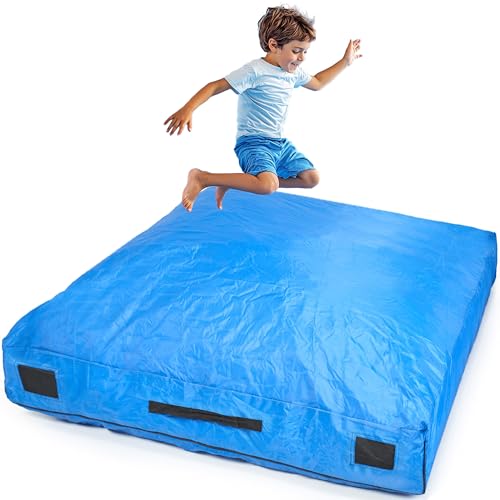
The Kosiproducts mat isn't designed specifically for sensory use: it's a gymnastics and martial arts crash mat, but it earns an honourable mention here as a solid budget option if you want to see whether your child will actually use a crash mat before spending significantly more. The dual-layer foam provides decent shock absorption, the non-slip base keeps it in place, and the water-resistant cover handles the kind of use children put things through. At around £60–70 for the 100 x 100 cm size, it's roughly half the price of the entry-level sensory-specific options. The trade-offs: less foam depth than the purpose-built sensory versions (10 cm vs 20–25 cm), and it comes in fewer sizes relevant to home sensory use. But as an entry point, it's a perfectly reasonable place to start.
Pros
- Significantly lower price than sensory-specific options
- Non-slip base and water-resistant cover
- Good entry point for trialling a crash mat
- Widely available and well-reviewed
Cons
- Not designed for sensory use: thinner foam (10 cm)
- Less shock absorption for harder landings
- Fewer size options suitable for home sensory rooms
Check Price on Amazon →
What to look for in a sensory crash mat
A few things worth thinking through before you buy, especially given the price range involved.
📐
Size and thickness
Bigger isn't always better if you're tight on space, but thickness really does matter. A 10 cm mat is fine for low-level tumbling; for children who really throw themselves at things or jump from height, you want 20–25 cm of foam or a dual-layer construction. Check whether the mat will bottom out under your child's weight — high-density foam holds up; cheaper foam can compress fully, which removes the safety benefit.
🧽
Washable covers
A removable, machine-washable cover is non-negotiable if this is going to be used regularly. Crash mats get sweaty, muddy, and occasionally worse. Check the wash temperature. Most are 30–40°C, and whether the cover can be tumble dried or needs to air dry. If your child uses theirs daily, having a spare cover while one is in the wash is worth thinking about.
🛡️
Non-slip base
On hard floors, a mat without a non-slip base will move. For a child running and throwing themselves at it, a shifting mat creates a trip hazard rather than a safe landing zone. Check whether the product specifically mentions a non-slip or anti-slip underside, not all do, and it matters more than it sounds.
🏠
Where will it live?
The larger sensory crash pads, particularly the round FINCOME or the ODOXIA 152 x 152 cm — are substantial pieces of kit. They work well in a dedicated playroom or sensory room but are less practical in a family living room where they need to be moved regularly. If space is limited, a mat with a carry handle (like the Whiffee) or the more compact sizes will be easier to manage day-to-day.
Where a crash mat sits within a wider setup is something I've covered separately in my guide to building a sensory room at home, which works through the movement zone alongside the quieter ones.
💰
Budget vs investment
The price range here is wide, roughly £60 to £310. If you're not sure whether your child will actually use a crash mat, the Kosiproducts option at the lower end is a reasonable way to test the waters. If you already know your child is a regular sensory seeker who needs this kind of input daily, spending more on a purpose-built mat with better foam and a washable cover will almost certainly be worth it in the long run.
🧠
Why crash mats help
For sensory seekers, particularly children with ADHD or autism, the act of crashing and landing provides proprioceptive input, which is the deep pressure feedback the body gets from impact and resistance. This kind of input can be genuinely regulating: it helps the nervous system calibrate and can reduce the urge to crash into people and furniture. A crash mat channels that need into something safe and intentional. It's worth reading my guide on building a sensory diet if you want to understand how this fits into a broader approach.
Frequently asked questions
Common questions about crash mats, answered.
What is a sensory crash mat and how does it help?
A sensory crash mat is a thick foam landing pad designed for children who crave proprioceptive input, the deep pressure feedback you get from jumping, crashing, and landing. For sensory seekers, particularly those with ADHD or autism, crash mats provide a safe, controlled outlet for that physical need. The impact of landing on the foam delivers the deep pressure input the body is seeking, which can help with regulation and focus. They're used in sensory rooms, OT clinics, and at home as a safe space for high-energy play.
Is a crash mat the same as a crash pad?
The terms are used interchangeably in the UK. Both refer to thick foam landing pads designed to absorb the impact of jumping and crashing. 'Crash pad' tends to be used more often in sensory and therapeutic contexts; 'crash mat' is more commonly associated with gymnastics or martial arts. The sensory-specific versions are designed with neurodivergent children in mind and often come with removable, washable covers.
What size crash mat should I get?
For home use, a mat around 120 x 90 cm gives a reasonable landing area for most children without taking over the room. Larger mats (150 x 150 cm and above) are better if you have the space and want more flexibility, particularly if your child loves jumping from a height or rolling across the surface. Thickness matters too: 10 cm of foam is adequate for low-impact use, but 20–25 cm provides much better shock absorption for children who really throw themselves at it.
Are sensory crash mats safe for children?
Yes, when used appropriately and with supervision. Always check the recommended age and weight limits for the specific product. Crash mats are designed to absorb impact. They are not trampolines, so children should not be jumping onto them from significant heights unsupervised. Many families pair a crash mat with a
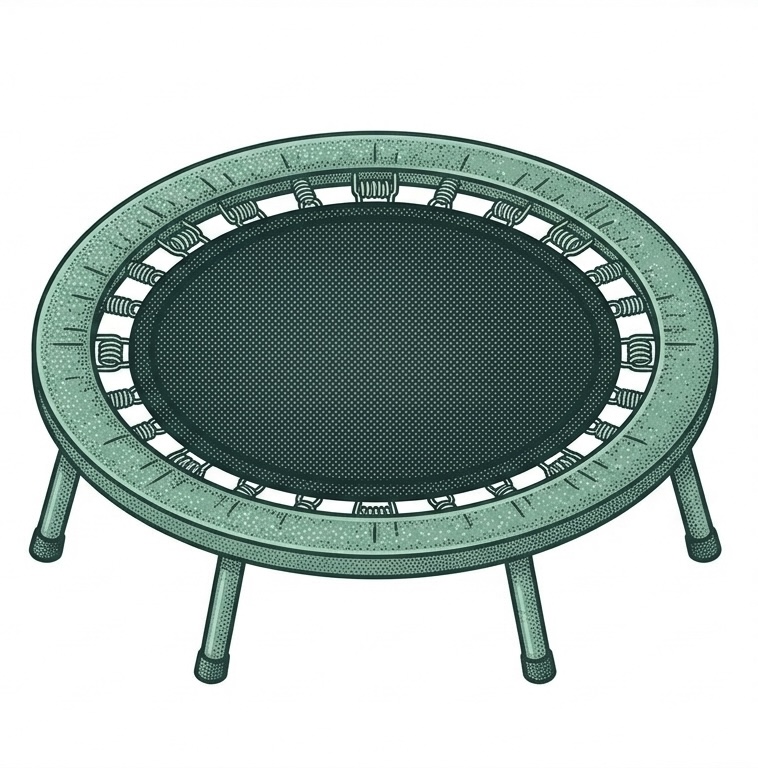
mini trampoline for a complete movement-seeking setup. They are generally safest on a hard floor rather than on top of carpet, which can cause the mat to shift. Always supervise young children during use.
Can crash mats be used outside?
Most sensory crash mats are designed for indoor use. The foam filling can be damaged by prolonged exposure to moisture, and damp foam is very slow to dry and may develop mould. Some covers are water-resistant for occasional outdoor use, but if you want something that lives outside, check the specific product's guidance carefully. In general, keeping them indoors and out of direct sunlight will extend their lifespan significantly.