Sensory Sorted Guide
How to Build a Sensory Diet for Your Child
Regular sensory input throughout the day reduces depletion, and reduces restraint collapse. Here's how to start building one at home.
They're "fine at school." Then they walk through the door and it all goes to pieces. Here's what's really going on, and why it means you're doing something right.
I'm a parent, not a professional. This article draws on my own experience with two neurodivergent children, and on published information from sources including the National Autistic Society, Sheffield Children's NHS, and occupational therapists who work with neurodivergent families. It is not clinical advice. If your child's after-school distress is severe or frequent, please speak to your GP or your child's SENCO about accessing professional support.
For about two years, I thought there was something specifically wrong with our afternoons. Ella would be reported as having a perfectly fine day at school: focused, compliant, social, no incidents, and then I'd collect her and within ten minutes of getting home, everything would detonate. Tears, shouting, throwing herself on the floor. Once she kicked a door hard enough to dent it.
The teacher saying "she was absolutely fine today" stopped being reassuring and started feeling like an accusation. Why was she fine there and not here? Was it me? Was it our house? Was it something I was doing wrong at pickup?
It took me a long time, and eventually an OT who used the phrase "restraint collapse", to understand what was happening. Once I got it, everything made sense. And I felt considerably less like a failing parent. If you need to explain what's happening to school — or request adjustments that would reduce the daily masking load — my School Meetings & Communication Pack includes meeting prep sheets and follow-up templates.
The term "after-school restraint collapse" was coined by Canadian counsellor and parenting educator Andrea Loewen Nair, and it describes something that many SEN parents will recognise immediately when they hear it explained. Throughout the school day, children, particularly neurodivergent children, expend enormous amounts of energy keeping themselves together. They follow rules they find confusing or arbitrary, manage sensory environments that are genuinely overwhelming, suppress their instinctive reactions, navigate complex social situations, and perform "normal" for hours at a stretch.
This is sometimes called masking, and for autistic children especially, it isn't a conscious choice so much as a survival strategy. Autism Awareness Centre describes it as consciously or unconsciously suppressing behaviours associated with autism that might be viewed as inappropriate in a given setting. The effort involved is real, and the toll it takes is real.
When your child finally gets home, to you, to their safe place, to the person who loves them unconditionally and won't judge them, the mask comes off. When that daily unmasking effort builds up over weeks or months without enough recovery time, it can tip into autistic burnout — a longer-term state that is worth understanding separately.'t judge them, the mask comes off. The regulation that has been held together by sheer effort all day collapses. And what you see is the accumulated cost of everything they held in during school hours.
"The moment I understood that Ella's after-school meltdowns were a sign that she felt safe with me, not a sign that I was causing a problem. Something in me shifted. She wasn't falling apart at home instead of at school. She was falling apart at home because she'd held it together at school. Those are very different things."
This matters, because the framing changes everything. If you see after-school meltdowns as behaviour problems, you respond with consequences and correction. If you see them as a nervous system doing exactly what it needs to do after a hugely demanding day, you respond with space, low demands, and patience. The outcomes are very different.
Restraint collapse doesn't look the same in every child. Sheffield Children's NHS Foundation Trust notes that autistic children will each have their own specific triggers and responses, and this is true of restraint collapse too. Some children explode. Some implode. Some do both on alternate days.
Sudden, intense crying, screaming or distress that seems out of proportion to what's triggering it in the moment.
Full sensory and emotional overwhelm, the child loses the ability to regulate and may not respond to communication until the storm passes.
The opposite of explosion — withdrawal, silence, going to their room, becoming unresponsive. Just as exhausted, just expressed differently.
Snapping at siblings or parents, lashing out, being easily triggered by things that normally wouldn't bother them.
Some children collapse physically — falling asleep, becoming lethargic, being unable to engage with anything for an extended period.
Being unable to start homework, chores, or even activities they normally enjoy. The tank is simply empty.
Jude's restraint collapse tends to look like the first type: lots of noise, lots of movement, lots of demands for attention. Ella's is more often the withdrawal kind: she goes to her room, closes the door, and needs a long time before she can engage with any of us. Both are restraint collapse. Both need the same basic response, even if the specifics look different.
All children can experience versions of this. It's not exclusive to autistic or ADHD children. But it tends to be more intense and more consistent in neurodivergent children for a few clear reasons.
Masking takes more energy. A neurotypical child isn't having to actively suppress their instinctive responses all day. An autistic child often is. They're translating a social world that doesn't come naturally to them, in real time, without a break. That's exhausting in a way that's hard to overstate.
Sensory environments are more demanding. A typical school is a lot: fluorescent lights, background noise, the smell of lunch, the unpredictable sounds of other children, scratchy uniforms. Neurodivergent children who process these things more intensely are managing significant sensory load all day, not just social load.
Emotional regulation requires more effort. Children with ADHD and autism can find emotional regulation harder than their neurotypical peers. Managing that throughout a school day uses resources that simply aren't there by home time.
There's something that many parents find oddly reassuring about this: the more your child saves it for home, the more they trust you. The reason Ella melts down with me and not her teacher is because she knows, at some deep level, that it's safe to. She's not saving her best behaviour for strangers out of spite. She's saving her worst moments for the person she trusts most in the world.
That's you. You're doing your job right.
I've put together a two-page printable covering the eight sensory tools I'd start with, what each one does, and rough price ranges — so you can keep it handy or pass it to school. Free, no strings.
There's no switch you can flick. Restraint collapse is a genuine physiological and neurological response to depletion, not a habit you can train out of a child. But there are things that reliably reduce the intensity and frequency of it.
No questions, no homework reminders, no instructions the moment they get home. Not even "how was your day?" Many parents find that even friendly questions feel like demands when a child is running on empty. A warm, low-key welcome: "good to see you, here's your snack", and then space is usually the best pickup strategy you can offer. Conversation happens later, when the child has refuelled.
Predictability helps neurodivergent children enormously. If the after-school sequence is always the same: snack, 30 minutes of their choice activity (a visual timer on the table makes this far less contentious), then the rest of the afternoon, the child knows what to expect, and the transition from school becomes less jarring. The decompression time should be low demand: screen time, their special interest, quiet sensory activity. Not "useful" activities you're sneaking in under the guise of rest.
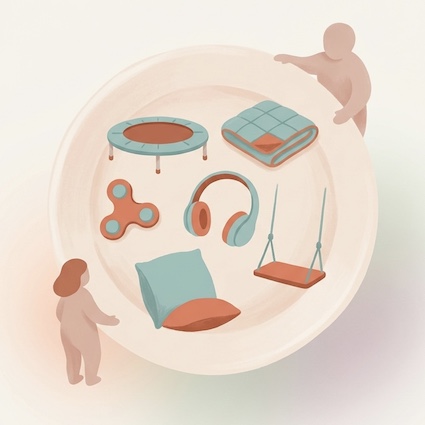
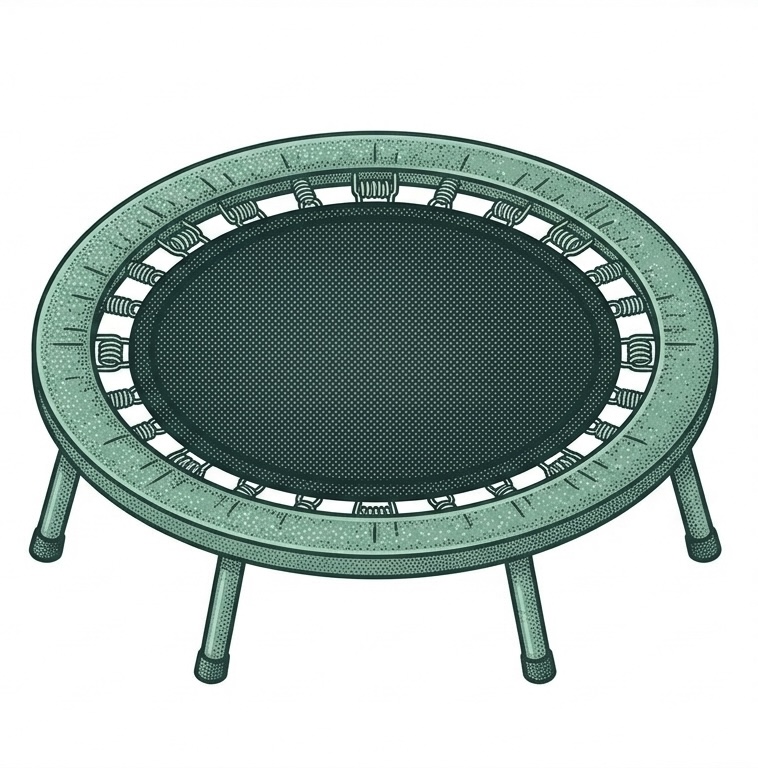
For many children, the after-school period benefits enormously from structured sensory input: a trampoline session, time on a swing, a weighted blanket, a bath. These aren't rewards. They're genuine tools for regulating a nervous system that has been overstretched. An OT can advise specifically on what kinds of input help your child regulate. Many parents find this is the single most effective thing they can add to the afternoon routine.
Immediately after school is the worst possible time to try to do homework with a child who has just depleted themselves maintaining regulation all day. It won't go well, and the fight costs more energy than the homework is worth. Many families find that waiting until after dinner (once the child has had real recovery time) results in homework that takes a fraction of the time and tears. Talk to school if homework volume is making this impossible.
When restraint collapse is in full swing, the child's capacity for rational thought is genuinely impaired. Trying to reason, explain, or problem-solve in this moment doesn't help, and often escalates things. Sheffield Children's NHS guidance on autistic meltdowns recommends removing your child from the situation calmly, giving them space, and avoiding conversation until the storm passes. Your job during a meltdown is to keep everyone safe and stay calm yourself, not to resolve anything.
If restraint collapse is happening every day and is very severe, it's worth looking at what's making the school day so depleting. Sensory breaks during the day, access to a quiet space, a key adult, reduced transitions. These are all adjustments that can be built into a child's SEN Support plan or EHCP. Restraint collapse is also usually at its worst in the first few weeks of a new term, which my guide to going back to school with a neurodivergent child covers in more detail. A child who is less depleted by home time will have less to release when they get there.
One of the more complicated parts of restraint collapse in our house is that Jude and Ella decompress in completely opposite ways. Ella needs quiet; Jude needs movement and stimulation. They wind each other up catastrophically in the first hour after school.
If you have multiple children, particularly multiple neurodivergent children. You might need separate decompression strategies for each. This can mean physically separating them for the first hour: one child in their room, one on the trampoline in the garden. It's not always possible, but even imperfect versions of it help.
It also helps to explain to siblings, in age-appropriate language, why things sometimes look the way they do after school. Ella's younger-sounding-than-she-is description of it is "my brain is full up and I need to empty it." That's a pretty good explanation, and it's one Jude has now learned to recognise and — mostly — respect.
Nobody talks about this enough. If your child is experiencing significant restraint collapse every day, the three o'clock dread is real. Many parents of neurodivergent children describe feeling their anxiety spike in the hour before pickup. You're not dreading your child. You're dreading the next two hours, which you know from experience are going to be hard.
SPACE Hertfordshire, a support organisation for SEN families, makes the point explicitly: if restraint collapse is happening regularly, your own stress levels will be rising before home time, and taking time to look after yourself before pickup matters. This isn't self-indulgent. A parent who is already running on empty and anxious is less able to provide the calm, low-demand environment that actually helps.
If things are consistently very difficult, talk to someone. Your GP, your child's SENCO, a SEN parent support group. You don't have to navigate this alone, and getting support for yourself is part of getting support for your child.


The things I get asked most when I talk to other SEN parents about after-school restraint collapse.